The Cannabis Equipment Glut: How to Get an APEX 7 Back to Ziel Standards
There is a lot of used cannabis processing equipment on the market right now, and there is nothing shameful about buying it. Consolidation, license attrition, and capital discipline have all pushed hardware into the secondary market at prices that would have been unthinkable when these machines were new. Brokers, auction houses, and operator-to-operator deals are moving extraction skids, packaging lines, environmental controls, and used remediation systems. If you bought a used Ziel APEX unit for a fraction of its replacement cost, you made a defensible business decision.
What you did not buy is a plug-and-play machine.
A used Radio Frequency system arrives at your loading dock with an unknown service history, unknown runtime hours, an unknown last calibration date, an unknown software version, and zero process validation documentation tied to your facility, your workflow, and your product. The steel may be in excellent shape, but the compliance file is empty. That gap is the real subject of this article, and it matters more in 2026 than it would have two years ago, because the April 2026 rescheduling action has started to pull cannabis manufacturing toward an FDA-style quality framework where equipment qualification is not a formality but an audit target.
What follows is a plain accounting of what has to happen to close that gap, what can go wrong if you skip steps, and what a recertification engagement covers.
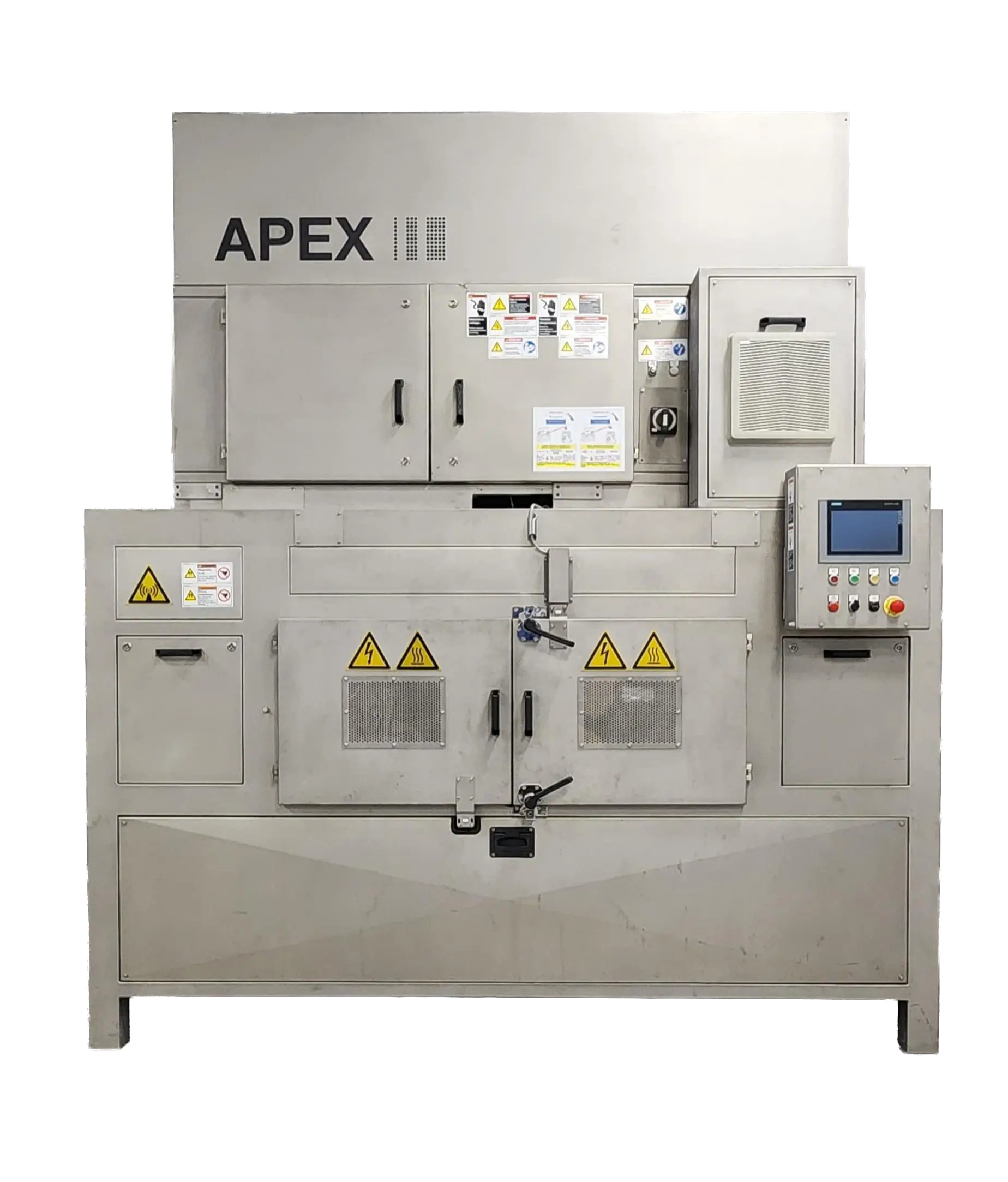
What You Actually Bought
A Ziel APEX 7 is a non-ionizing Radio Frequency microbial control system. It works by using RF energy to raise the temperature of moisture inside plant material rapidly and volumetrically, which is what drives microbial reduction without the surface-only limitations of steam or the regulatory apparatus that follows gamma and e-beam irradiation. That physics does not degrade in storage. It is the reason a used unit is worth buying at all.
When a unit changes hands, the components most likely to be intact are the mechanical and structural ones. A competent inspection will tell you quickly whether the unit is in serviceable condition.
Software Compliance and Readiness
Ziel has had significant software updates and updated SOPs over time. Those updates carry parameter controls, safety interlocks, data logging behavior, and recipe management improvements. A unit that has not been updated in eighteen to twenty-four months may be running a deprecated version. Ziel has taken the last decade of cannabis experience to enhance their SOPs, recipes, and software compliance — ensuring your APEX 7 has the latest software that guarantees audit compliance and the highest of industry standards when it comes to remediation.
Calibration Status is Unknown, and Unknown Is the Problem
Ensuring your APEX 7 is up to date and has the most current and up-to-date parts ensures a steady outcome of product; this is where our Reconditioning Package excels, and we guarantee success during our commissioning process.
The Validation Package Belongs to the Previous Operator
This is the point most buyers underestimate. If the seller had a complete Installation Qualification, Operational Qualification, and Performance Qualification package, that documentation was generated for their building, their electrical infrastructure, their ambient conditions, their product formats, and their target organisms. It is a record of what happened somewhere else. It is useful as a reference and as evidence that the platform is capable, but it is not transferable as your qualification evidence.
Your Post-Harvest Set Up
The unit does not know your incoming material moisture content, your product density, your strain profiles, your throughput targets, your target log reduction, or your state's microbial limits. Every one of those variables changes the process window, and requires Ziel's SOPs to ensure a successful outcome.
The hardware price is not the total cost of ownership; commissioning and learning how to use the APEX 7 is what makes it a valuable investment.
Why Compliance + SOPs Matters More Under Schedule III
None of the above is new as a quality principle. What has changed is the probability that someone with federal authority will ask to see it.
DOJ + DEA order places qualifying marijuana products into Schedule III
Expedited hearing on broader Schedule I → III rescheduling begins
On April 23, 2026, the Department of Justice and the Drug Enforcement Administration issued an order placing FDA-approved products containing marijuana, and marijuana products regulated under a qualifying state medical marijuana license, into Schedule III of the Controlled Substances Act. The same announcement initiated an expedited administrative hearing process, beginning June 29, 2026, to consider the broader rescheduling of marijuana from Schedule I to Schedule III. Broader rescheduling is not finished; the order that took immediate effect was narrower than the headlines suggested. But the direction of travel is now explicit, and it points toward greater FDA involvement in the cannabis supply chain.
For equipment owners, the relevant consequence is the quality framework that comes with FDA oversight. The current good manufacturing practice regulations for finished pharmaceuticals in 21 CFR place substantial weight on equipment: that it be suitable for its intended use, that it be properly installed and maintained, that calibration of instruments and controls be performed on a written schedule with records retained, and that processes be validated so that a manufacturer can demonstrate a process consistently produces a product meeting its predetermined specifications. Equipment qualification and process validation are not paperwork attached to the real work. In a GMP inspection, they are among the first places an investigator looks.
A used remediation system with no current calibration record and no facility-specific validation package is, in that world, a finding waiting to be written.
State regulators are moving in the same direction on a different track. Microbial limits for cannabis remain a patchwork, and total yeast and mold count thresholds vary widely by jurisdiction, with some states enforcing tight numerical caps, others enforcing looser ones, and some relying on pathogen-specific testing rather than a TYMC ceiling. Confirm your own state's current limits directly with your regulator, because these rules change frequently. The structural point survives whatever the numbers are: if limits eventually converge toward a federal floor, every operator will need to demonstrate that their remediation process reliably meets that floor. An unvalidated machine cannot make that demonstration, no matter how well it happens to be performing.
There is no reason to be alarmed about this, and no reason to rush a decision out of fear. The honest framing is that documentation is becoming more valuable, not less, and that building the record now while you control the timeline is considerably easier than assembling it during an inspection, a recall investigation, or diligence on a sale.
What Reconditioning Actually Involves
Ziel offers a recertification engagement for exactly this situation, priced at $85,000. Here is what the scope covers, in plain language.
| Scope | What it covers |
|---|---|
| 1 Software update. | The unit is brought to the current firmware and control software release, so you are operating a supported version with current parameter controls and logging behavior. |
| 2 Reinstallation and recommissioning. | Physical inspection; electrical verification against your facility's supply; mechanical checks; and RF output measurement taken in place at your facility rather than inherited from a prior site. |
| 3 Process validation support. | Direct work with your team to establish IQ, OQ, and PQ documentation appropriate to your facility, your product profiles, and the microbial standards you are held to, including help defining acceptance criteria before the qualification runs rather than after. |
| 4 Operator training. | Hands-on training for your staff on the unit as configured, with documented completion records you can put in a personnel file and hand to an inspector. |
Eighty-five thousand dollars is not a small number, and it deserves to be weighed honestly against what you paid for the machine. What it buys is the difference between a unit that occupies floor space and a unit that produces results you can stand behind in front of an auditor, a wholesale purchaser conducting supplier qualification, or an acquirer reading your quality file during diligence. Whether that trade is worth it depends on your volumes, your state's enforcement posture, and how much of your revenue depends on lots passing microbial testing the first time. That arithmetic is yours to run.
It is worth naming what the alternative looks like, without exaggeration. Operating an unvalidated remediation system means you are relying on the platform's general capability rather than evidence about your process. In practice, that shows up as inconsistent results between lots, remediation runs that fail to hit the target log reduction, and an inability to produce qualification records when a buyer or regulator asks. None of those are certainties. All of them are avoidable.
Where This Leaves You
Buying a used radio frequency remediation system is a legitimate choice, and in a market with this much equipment moving, often a smart one. It just comes with an honest accounting attached. Four things did not transfer with the machine: the software version, physical part replacements and upgrades, GMP Validation, and warranty. Closing those four gaps is what turns purchased hardware into a qualified process step that earns its place in your production flow.
The regulatory environment is moving toward rewarding operators who did that work and exposing the ones who did not. Doing it on your own schedule is easier and cheaper than doing it under pressure.
If you've acquired a used Ziel unit and want to understand what Reconditioning Services look like for your facility, start here.
Source: U.S. Department of Justice, Office of Public Affairs, "Justice Department Places FDA-Approved Marijuana Products and Products Containing Marijuana Subject to a Qualifying State-issued License in Schedule III," April 23, 2026. Regulatory context on equipment qualification, calibration, and process validation reflects 21 CFR Part 211. State microbial limits change frequently and should be confirmed with the applicable state regulator.