Beyond Flower: Is Europe's Medical Cannabis Market Turning Pharmaceutical?
Recapping Ziel's Day 2 panel at Cannabis Europa London 2026, thanks to Ben Stevens at Business of Cannabis for the Transcript of this Panel.
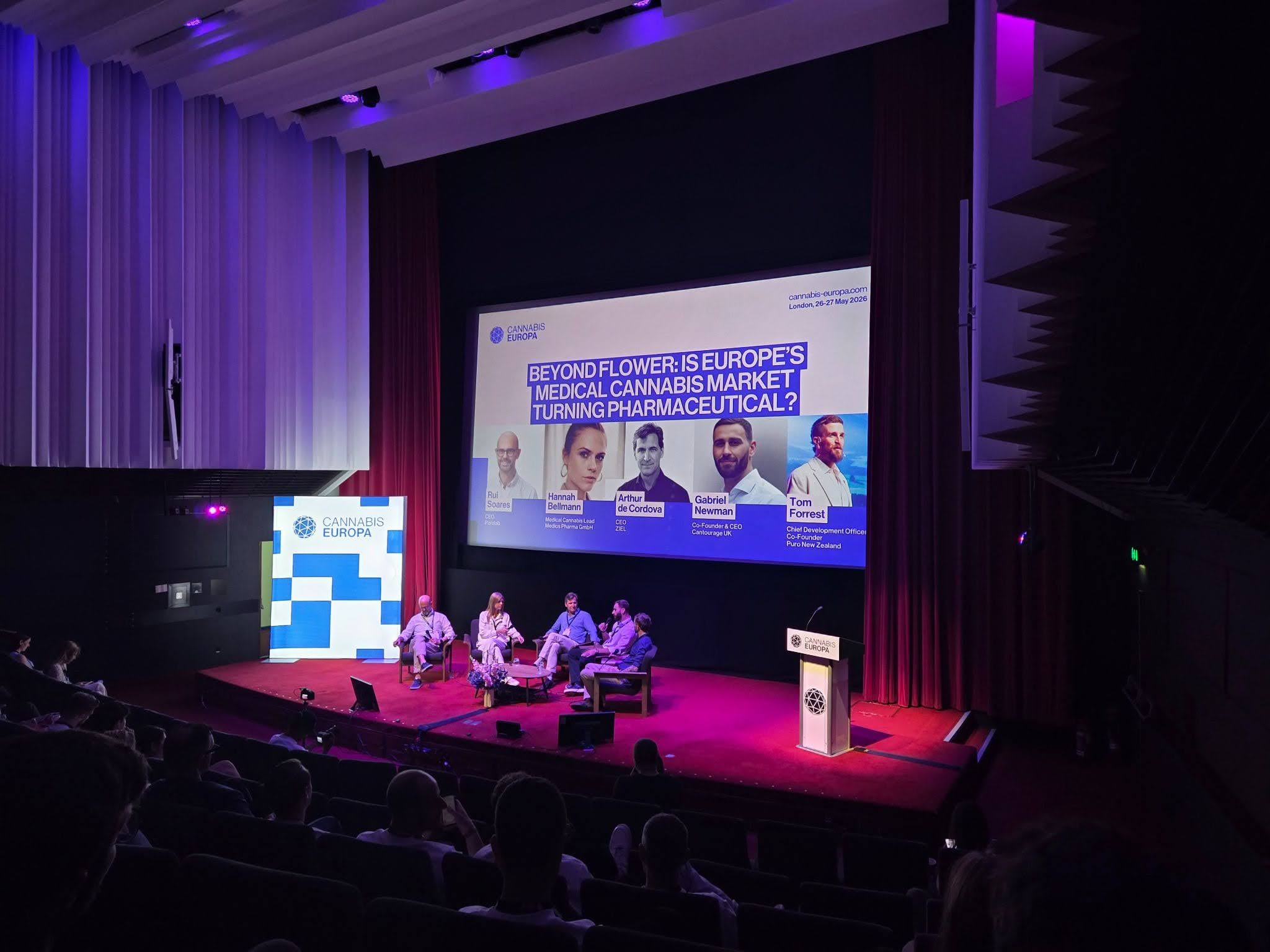
For years, flower has defined Europe's medical cannabis market — familiar to patients, fast-acting, and dominant in every major prescription market on the continent. But as Spain builds a system around standardized oral preparations, France advances a medical model that excludes raw flower entirely, and regulators across Europe signal a preference for products that look and dose like conventional medicines. One question hangs over the industry: is Europe genuinely moving beyond flower?
That was the question Ziel CEO Arthur de Cordova put to the closing panel of Day 2 at Cannabis Europa London 2026, joined by Tom Forrest (Puro New Zealand), Hannah Bellmann (Medios Pharma), Rui Soares (Paralab), and Gabriel Newman (Cantourage UK).
The panel's answer? The industry is asking the wrong question. Europe isn't moving beyond flower. It's moving beyond inconsistency — and post-harvest technology is what makes that move possible.
Here are the five takeaways that stayed with us.
1. Flower Isn't the Problem - Unstandardised Flower Is.
Nobody on the panel predicted flower's demise — least of all Hannah Bellmann, speaking from inside Germany, Europe's largest and most flower-heavy market.
Flower is, and always will be, the starting material. Certain patients will always need flower therapy, because it's different — you can't compare flower therapy to extract therapy. I don't think we need more flower. I just think we need highly standardised flower.
Hannah Bellmann · Medios Pharma
Gabriel Newman made a parallel point about the UK: today's heavily flower-based market reflects an early-adopter patient population that isn't cannabis-naive.
"As we broaden the patient base, of course there's going to need to be more delivery methods." The format mix will diversify — but not because flower fails, but because the patient base grows.
Gabriel Newman · Cantourage UK
De Cordova's per-capita comparison between Germany's current ~200 tonnes of annual consumption and the US state of Michigan points to a potential ceiling of 1,450 tonnes at full market saturation. Different market, different model — but the headroom is real.
2. Post-harvest Technology is the Key to Standardisation.
If the destination is standardised, pharmaceutical-grade products, whether flower or formulation, the panel was clear about the vehicle that gets the industry there.
The post-harvest technologies that allow this level of standardisation — that's going to be the main draw card. What we grow in the field, bringing that exact profile to the patient — it's hit and miss.
Tom Forrest · Puro New Zealand
Forrest pointed to the trends closing that gap: solventless extraction that naturally retains profiles, and nano emulsion that truly captures the plant's original compounds.
The technologies that people are bringing to market now are years ahead of what we had five years ago, from decontamination and sterilisation through to packaging and extraction and product formulation. Flower that reflects what that flower should have been at farm gate, right through to pharmacy.
Tom Forrest · Puro New Zealand
That farm-gate-to-pharmacy integrity is the thesis Ziel was built on. Standardisation doesn't happen in the grow room alone - it's won or lost in everything that happens after harvest.
3. Consistency is the Price of Admission — and GMP is Workable.
Rui Soares brought the compliance perspective that underpins all of it.
We are in an industry where we have to show consistency. We have to make sure that we are always doing consistent, safe products.
Rui Soares · Paralab
But he pushed back on the idea that EU-GMP is a rigid straitjacket.
Guidelines are just medical principles. You can go on the hard line, or you can have a more open mind. Just be ready to find and refute any objection of the auditors. If you give them good technical facts, they should not be able to refuse.
Rui Soares · Paralab
In other words: GMP rewards operators who can defend their processes with data. Sound science, well documented, wins audits.
4. The Industry Has a Language Problem — and an Education Gap.
Standardising the product is only half the job; the industry also has to standardise how it talks about it.
Newman described the perception trap in the UK: the regulatory category is CBMPs - cannabis-based medicinal products - but the word patients and the public hear is simply "cannabis," and they run to their own conclusions. Simple adaptations, like saying "cannabinoid medicines," help reinforce the pharmaceutical framing the category deserves.
Forrest was blunter about the cost of Europe's advertising restrictions:
Not being able to celebrate great patient outcomes with great stories — finding feedback on Reddit as the number one review for products is just astounding and painful.
Tom Forrest · Puro New Zealand
And the classification system itself needs to mature.
It's not just THC, it's not just CBD, it's not just four or five terpenes. We need to look far beyond this surface-level basic understanding... We have not even scratched the surface on that yet.
Tom Forrest · Puro New Zealand
Bellmann pointed to an underused ally in closing the education gap: the pharmacist. Prescribing starts with the physician, but the pharmacist is the last — and often most trusted — point of contact between medicine and patient.
The pharmacist has a function to be there to educate, to help out, to give you trust.
Hannah Bellmann · Medios Pharma
5. The Best Question Came from the Audience.
Near the end of the session, an audience member reframed the entire debate.
It landed because it dissolves the false binary. Bellmann had already touched the same nerve: cannabis never treats a sickness — it always treats symptoms. Patients don't want flower or extracts or tablets. They want relief that is consistent, safe, and repeatable — in whatever format serves their condition, their age, and their life.
Cannabis never treats a sickness. Cannabis always treats symptoms.
Hannah Bellmann · Medios Pharma
Forrest predicted the market will sort formats on exactly that basis. A full-spectrum soft gel with lower dose and higher efficacy will outcompete an isolated-THC tablet for many patients - though tablets will always have a constituency, particularly among elderly patients and veterans.
The quality of the tablet will determine whether it sells.
Tom Forrest · Puro New Zealand
Quality decides. Which brings the whole conversation back to where it started.
Europe isn't turning its back on flower.
It's raising the bar for everything.
Flower, extracts, and finished formulations alike — the direction of travel is unmistakable: toward consistency, standardisation, and pharmaceutical-grade quality from farm gate to pharmacy. That transition runs directly through post-harvest technology. Decontamination that protects patients without degrading the product. Processing that preserves the plant's true profile. Data that stands up to any auditor.
Ziel's radio frequency technology helps cultivators and manufacturers worldwide deliver clean, compliant, profile-true cannabis at scale.